The State of PR, Marketing, and Communications: You are the Future
This post is long. If you prefer a Word or PDF version, please click here to download.
Please take your time...Read it. Breathe it in. Live the change you wish to see.

Source
Modern Public Relations was born in the early 1900s, although history traces the its roots and origins of practice back to the 17th century. Two years ago, the press release celebrated its 100-year anniversary.
While the communications industry has iterated with every new technological advancement over the last century, including broadcast mediums and Web 1.0, none however, have forced complete transparency prior to the proliferation of the Read/Write Web aka The Social Web aka Web 2.0.
It is this element of fundamental transparency of Social Media combined with its sheer expansiveness and overwhelming potential that is both alarming and inspiring PR professionals everywhere. At the minimum, it’s sparking new dialogue, questions, education, innovation, and also forcing the renaissance of the aging business of PR itself.
While some are already predicting the death of PR, I fundamentally believe that it’s simply the death of PR as we know it. As long as communications professionals want to learn and improve their craft, then we are positioned for evolution. No matter how much we think we know, we’re now equalized as an industry in order to reset, learn, and define and earn an invaluable role within the business cycle – again.
Contrary to popular belief, Social Media isn’t killing PR, but the business of PR IS in a state of paramount crisis. It’s not without merit however. Perhaps up until now, we have been our own worst enemy.
The Social Web, the democratization of content and the wisdom of the crowds is merely amplifying PR’s weaknesses and expediting the declination of a broken business model. As is, many of us are collectively contributing to its perceived insignificance and irrelevance.
But there’s hope and that hope is you...
Our future lies in our ability to shift PR from a business of publicity to a regiment of true “Public” Relations.
Abbreviating "PR" truncates the value of our role in one of the greatest transformations the communications industry has ever witnessed.
As good friend Nicole Jordan told me over dinner in NY recently, “PR stands for Press Release, not Public Relations. When people ask me what I do, I tell them that I’m in integrated communications – public relations today is about much more than press releases and pitching and I am so much more than just a PR person.”
Indeed. Just ask any executive what comes to mind when you say “PR” and note the common misperception shared by many decision makers.
The brutally honest responses, whether you agree or not, will represent more than we’d care to know or acknowledge. The assessments and responses will most likely span from “publicist” to “networker” to “press release” to some fallaciously degrading and sexist stereotypes of what PR people are, how they act, and what they look like. You’ll also summon war stories and bad experiences with PR people and agencies that unfortunately continue to reinforce the current state of PR crisis for the PR industry in general.
There are reasons we are where we are and unfortunately, the PR industry hasn’t hired a crisis communications team to alter or steer perception based on the industry-leading and groundbreaking work, results, and pioneering efforts of many.
Let's be honest. At one point or another, we as communications professionals HAVE contributed to this state of crisis.
Yes, I’m speaking directly to you.
I hold the mirror up as I comb through my professional endeavors.

I too am guilty of hitting send on spam blast emails and broadcasting “messages” at “audiences.” I have also contacted reporters without reading their work. I have been blinded by quantity, not quality. And, I have sacrificed the investment in relationships for the gamble of percentages, hoping to turn big campaigns into measurable pockets of coverage and visibility. My career, in the beginning, was defined by hits and coverage and whether those articles and stories were "on message."
Since the mid 90s and with the dawn of Internet, I’ve dedicated myself to not only reinventing how I practice public relations, but also sharing my experiences, successes, stumbles, and failures with others who care to learn and improve a global industry from the inside out.
To this day, I remain continually, focused on investing in positive, constructive, and highly detailed blueprints on how we, as a communications industry, must embrace the socialization of the Web to transcend the foundation and very essence of PR into a more meaningful, relevant, and lasting renaissance.
I join the ranks of many great and generous public relations and communications professionals who actively invest in its promise and overdue maturation to strengthen its hope and future while playing a role in the unification of those passionate people who are dedicated to its transformation. This is a position of which I'm still firmly rooted and committed.
PR Won’t Change Until It Has To
Social Media symbolizes a crossroads for public relations representing the decision we, as individuals, face in our career. In one direction, we can adopt the transparency and the expertise necessary to genuinely and sincerely connect directly with our customers, peers and the influencers who advise them. In the other direction, we can continue relying on hyperbole and jargon filled press releases for coverage, spamming targets with irrelevant information, maintaining a superficial and shallow knowledge of the products and industries we represent, and maintaining distant and removed relations with those we wish to cover our stories.
In 2007, I shared a heartfelt conversation with my good friend Tom Foremski, where we outlined the state of PR and also what was required in order to lead and also survive the transition to the new era of marketing communications. His observation was best distilled with a blunt and poignant statement, "PR won't change, until it has to.”
As long as PR agencies and consultants are profitable as is, why would they reinvent themselves?
As some of us are learning, not challenging the status quo, especially in this economy, is the most direct path to oblivion...unfortunately, many are learning of the perils of "doing this wrong" through public exposure in a very global town square.
Contemporaneously, other communications professionals or organizations are rushing to capitalize on the new gold rush by adding everything "social" to their menu of services, mission, and experience, misrepresenting the very premise of their ebbing capabilities to masquerade inexperience in an exaggerated cloak of proficiency and expertise. Even in the face of intense competition to own the conversation, agencies are simply folding in new “social” services governed by the same top-down processes that govern day-to-day traditional PR. It’s a survival vs. adaption philosophy.

Hugh MacLeod
United as an industry that is dangerously slow to heed repeated dire warnings and adopt new standards, we will fail. Divided as individuals hungry for education and advancement aligned with those thought leaders and proven practitioners of new communications, we can collectively assemble a new and powerful collective of streetwise revolutionaries who will effectively transform, magnify, and upgrade the infrastructure of PR.
As much as you hear that all of this advice is Marketing 101, the marketing infrastructure is actually designed to function counter-intuitively. Intention and execution are distances separated by reality. We speak through hyperbole, spin, specifications, statements, and top-down messages. We continue to broadcast these disconnected campaigns in an era when our intended recipients have “opted out” of any outreach that pushes an agenda on faceless audiences through unemotional voices without recognizing the people formerly known as the audience (thank you Jay Rosen).
Personal vs. Corporate Branding
Don’t limit your expertise to personal experience with the use of social tools and networks. Your credibility, reputation, and knowledge must represent your command of them in action, both successes and failures in real world b2b, b2c, and p2p (peer to peer) engagement – not simply based on your efforts tied to personal branding. It’s one thing to build a community around you and your online persona, it’s altogether something different and much more complex and sophisticated, to create and inspire an active and passionate community around a product, service, and ultimately a brand.
With the powerful undercurrent of Social Media surrounding our personal and professional activity, we are now brand managers, not only for the companies we represent, but also our personal brands and reputations as well. If you’re not proactively shaping and cultivating it, who is?
We are our own brand managers now, responsible for how our personal brand and reputation as well as those we represent, are perceived, embraced and promoted. We learn through listening and participation. There is no excuse for our complacency as the failure in today’s landscape is public, searchable, and enduring.
Here Come the Social Media Experts
Credit
Traditional PR and marketing is on the endangered species list and this is that moment in time when its fate is in the hands of those who are contributing to its evolution or its demise. The veritable problem is that those who are instrumental in its downfall are oblivious to it. Everything is reactive, based on economics or negative responses that threaten their position in the market.
However, Social Media is not our golden ticket. It is both an opportunity and a privilege.
Applying the old rules and methodologies of communications to the new world of parallel influence only expedites the irrelevance and resentment of public relations and marketers overall.
Some PR teams and agencies are attacking the evolving business of PR by hiring thought leaders and injecting them into an existing infrastructure that’s complicated by years of hurdles, broken lines of communication, politics, and a misaligned hierarchy that prevents the most qualified individuals from leading and participating in successful online engagement for the long term. At best, most everything is viewed as a "campaign."
Other brands and PR teams are also attempting to rally posts, articles and tweets by paying or giving away products in exchange for coverage and good will. The practice has already earned the attention of the FTC and they’re issuing guidelines to ensure that bloggers and now Twitterers disclose the fact that they’re paid, whether with money or products.
Even after highly influential journalists and bloggers such as Chris Anderson and Gina Trapani have published the names of individual PR 'un' professionals and organizations that they consider spammers, we still actively push our messages to anyone and everyone as if we are determined to destroy any hope and potential of success - all in the name of scoring that one hit that will earn accolades and erase all of our wrongs.
Are we not more than publicists, handlers or even worse, spammers?
Why are the most junior people within any organization maintaining direct dialogue with leading influencers within their industry?
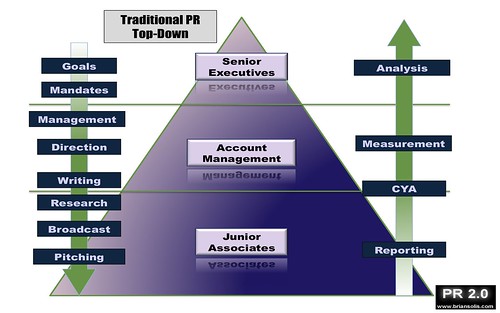
PR has entrenched itself in a top-down model that places strategy and direction at the top, management in the middle, and execution at the bottom. In a sense, many organizations are putting its most inexperienced and unseasoned employees on the front lines of PR while guiding them with strategy based on previous experience and/or theory, which may or may not be outdated and ineffective in today’s diverse and potentially perilous communications climate.
Things move too quickly to not combine experience, strategy, and execution in one role.
With the new and pivotal opportunity presented by Social Media, we again, are mistakenly and unfortunately, applying the same methodologies to program planning and engagement.
Social Media didn’t “invent” conversations and it did notunearth online conversations either; nor did it provide, for the first time, platforms for consumers to share their thoughts, opinions, and advice. Online groups and opinion sites existed since Web 1.0. And, before that, bulletin boards and forums hosted online discussions.
Contrary to popular belief, there are actually relatively few “Social Media Experts.”
As I’ve said many times, the ability to master any subject that moves, adapts, transforms, and evolves so quickly is beyond mastering – at least for now. We are, for now, simply its dedicated students.
Even still, several Social Media experts are predominately selling strategy and consulting because right now, everyone is buying it. Unfortunately, they’re helping companies understand the mechanics of Social Media tools and “conversations,” showcasing and promoting capabilities, functionality, and also providing training, but still delegating the execution to more junior marketing professionals, including interns and students. Most of this is rooted in theory as instead of experience.
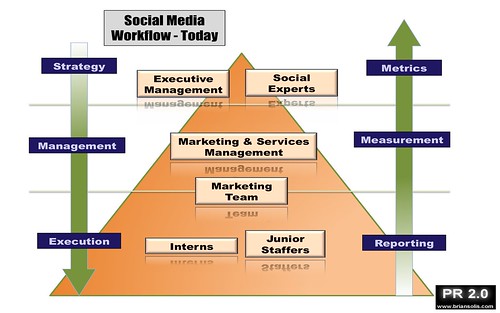
Again, why would we entrust our most important outreach and engagement to those who most likely have no bearing on the real life needs, pains, challenges, and choices of those we’re hoping to compel? Yet, they are the very teams we’re sending out to represent our brand each and every day. And expert guidance from the top doesn’t translate company-wide unless they’re part of the day-to-day team demonstrating and teaching through example.
So, when a blogstorm or Tweetquake erupts, who’s really to blame?
Do we condemn the less seasoned employees who are simply executing based on “expert” instruction or lack thereof? Do we hold leaders accountable because they’re the masterminds behind most outreach? Or, is executive management liable simply because their expectations are out of synchronicity with reality?
The answer is all of the above.
However, PR and social marketers will point to account managers because of their unattainable and out of touch presumptions. Senior level managers will charge those who fail with incompetence. Those on the front lines will charge their management with leading through ineptitude, but they still sign the checks.
With the radical changes underway in the communications and media spheres, we need to not only retrofit PR and marketing with new techniques and strategies, but reconstruct its entire model for the Social Web, accounting for the complex and elaborate two-way layers of traditional and new influencers and the communities that form around them and the ideas they represent.
We just have to reinvent how we structure, monetize, and capitalize on the opportunities that are ripe for the entire industry of qualified communications professionals.
Relationships Aren’t Built by Copying and Pasting Content
We’re not as far as you’d like to think. Here are two very recent and real examples of pitches that I’ve received:
Dear Brian, I love your blog. I read it all the time. You really are a thought leader on this front. Because of that, I have something that I think is really worth your time. We're launching a new social network for plants where people can share their recommendations and experiences and also comment on each other’s green thumbs. We are also introducing a new plant monitoring application that lets you know via gmail and text when you need to water or feed your plants.
I don’t write about plants. But just because I’ve written about “social networks” doesn’t necessarily mean I would ever cover a social network for plants.
Then there are also those PR people who are moving way too fast for their own benefit:
Hi Liz, I love reading GigaOM. CUT AND PASTE PITCH HERE.
That’s right. I’m not Liz and I don’t yet write for GigaOm. However, every day, I, along with every reporter and blogger out there, receive a significant number of shotgun aka “spray and pray” emails that are produced from pure mail merge factories,
Slow down.
You’re contributing to the atrophy of our profession. This is exactly the moment when we need to realize that we can offer more to the company we represent and the people we’re trying to reach.
Rather than trying to satisfy quotas, realize that the PR and marketing industries are undergoing an incredible metamorphosis, one that implores a "less is more" strategy, rooted in the connectedness of real people. In the era of the Social Web, a few key posts and articles in the right places, supported by an impassioned community bound by evangelism, success is significantly more profound, and immediately measurable. New PR suddenly starts to pave a clear and effective new path for day-to-day engagement for those who are ready to learn, mature and excel.
PR is So Much More than Media, Analyst and Blogger Relations
Credit: Ghedo
The business of PR slowly evolved away from public interaction and eventually transformed into a mechanism of media, analyst, and blogger relations to instill messages and attempt to manipulate public behavior.
PR = Publicity
This view of PR can be traced all the way back to Edward Bernays in the early 1900s. A nephew of Sigmund Freud, Bernays’ experimented with Freud’s ideology related to people's unconscious, psychological motivations and how they could be exploited or steered through communications and top-down influence. As a result, PR of today is more aligned with Media, Analyst and Blogger relations and not necessarily “Public” Relations.
Now that the creation and distribution of content has been democratized, everyday people are earning a level of authority that fundamentally works against the current model of current PR.
As described in my book with Deirdre Breakenridge, “Putting the Public Relations,” the Web, heightened with the proliferation of the read/write Web and the impending semantic Web, is forcing the integration of the “Public” back into Public Relations.
Applying the current process of pitch development and distribution has little to no impact on your numbers and your potential to survive the evolution of communications. In fact, this process works against you by alienating you and the brands you represent, closing valuable inroads to reach the very people who can make or break your business.
By simply adding bloggers to your mail merge or your “hit” lists, you are not adapting to the new landscape of influence and engagement, only contributing to its state of crisis. Bloggers are people too, and their in boxes are just as chaotic as those of their journalist counterparts.
Source
Social Media is bigger than simply integrating a Blogger Relations branch to your PR strategy. It’s an opportunity to engage directly customers and peers who either purchase or recommend the decisions of others. Engaging and inspiring these individuals requires new techniques, methodologies, and an undeniable understanding of who they write for and why they should care about what you represent.
The new world of influence demands customer empathy, evangelism, passion, expertise, and knowledge – everything else is disposable and takes away from your focus and potential.
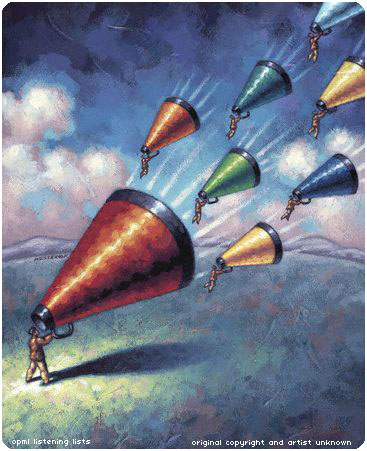
Doc Searls spotlighted the people who define our audience on the other side of our messaging megaphones to magnify the reality that markets are conversations and that there really is no discernible market for our pitches and messages.
Over the years, my experience with direct engagement has revealed that conversations are also markets - within vertical segments. Traditional word of mouth, at the consumer level, is intensified as impassioned individuals now have access to new mediums that directly and indirectly influence the decisions of their peers in the real world and through their extended communities online.
So how does PR attempt to engage with these new influencers?
Other than pitching at them and broadcasting messages through any and all channels and networks, many PR people attempt to either pose as “users” or offer boilerplate comments and reviews across the blogosphere, in micromedia communities, online groups and social profiles and review sites. This isn’t participation. This is PR of old. It embodies the same spin that defines most press releases along with the disingenuous voices associated with ghost-written executive quotes, contributed articles and now blog posts.
Listen, engage, prioritize, and grow in the communities that affect your development, reputation, relationships and authority as a person and as a professional. It's the only way...
Listening is the fundamental characteristic that separates the experts from the theorists.
The process of actively observing and documenting relevant conversations not only enables the communications team to create an accurate social map of important and relevant networks, but it also produces a more informed and empathetic assembly of sincere, humanized evangelists and ambassadors. This is a critical observation and lesson. We emerge from the process of listening and internalizing in tune and in touch with our markets and the people who define and direct them.
Blasting messages to them now seems trivial and purposeless. Engaging, solving problems, and answering questions, essentially becoming community and customer resources becomes paramount and natural. We participate as consumers and ultimately as the customers we wish to reach. It fuses customer service and influence. As next generation communications professionals, we're walking a tightrope between earning attention and building community, without losing sight of our ultimate goal of propagating our value propositions.
It is the job of any good Public Relations professional to identify and guide influential voices within important online communities.
Transparency Begets Authenticity; Experience Engenders Authority, and Influence
Transparency scares the sh!t out of PR people. This is an industry that has long operated behind the puppet master’s curtain, pulling the strings for spokespeople and varying communications tools to broadcast content at, around, and through the back channel of influence, but never directly connecting with the people who define its audiences.
The democratization of content also dictates the success, “shareability,” and permeation of your story by revealing and refining it through public forums and channels – let the community guide how you approach them.
The Social Web forces you to participate as an individual, not as a marketer and thus requires a new depth of understanding, expertise, knowledge in order to establigh a meaningful relationship between customers, influencers, and the company and products you represent.
Whether you post a comment, write a blog post, upload a video, create a profile on a social network, or establish groups or fan pages, everything is now open to public dissemination, interpretation, and response. Email too, long considered a safe medium for exchanging or presenting information, is now backfiring for PR, fueling bloggers and media to respond with a deep-seeded necessity to seek retribution by posting of original pitches and creating public blacklists that absolutely devastate PR individuals and their standing within their respective industries. While I don’t agree with public humiliation, it is an unfortunate reality that we must contend with while fighting and promoting the ethics of human relationships. Nonetheless, the lesson here is that we are now forced to change how we approach people with our stories. It's for our own good and the overall betterment of our craft.
A New Business Model and Infrastructure for Public Relations

Credit: Pear Biter
At South by Southwest (SXSW) in March 2009, Erin Portman, Karly Hand, Peter Shankman and I participated in a highly anticipated and heavily attended session entitled, “Are PR Agencies Dead?”
Some people would object to the use of “dead” in the title of anything these days. But, is it really a tired discussion in the grand scheme of things? Maybe, it’s stale to those who ping pong the discussion in the echo chamber. But for the rest of the world, it’s a topic that is either new or soon to be introduced into their world.
The controversial session explored whether or not Social Media was killing PR or breathing new life into it. In the end, it’s actually a bit of both. And, along with it, Social Media is forcing the establishment of new business models, staffing infrastructures, and service portfolios.
To be clear, the practice of blindly broadcasting messages through poorly written press releases at audiences is dead. PR is NOT necessarily dead, but without the application of a social tourniquet, it is bleeding to death.
Essentially, this is a matter of livelihood and the evolution of marketing and PR is incredibly poignant to each and every one of us.
At the end of the day, we are now in the business of visibility, influence and perception management. So, we can now put away the white coats associated with spin doctoring. We can remove the blindfolds we wore in every mass blast we sent. And, we can hang up our plaid jackets associated with the snake oil salesmanship we were accused of oozing in every exchange.
We now need to rethink our roles as intermediaries between the companies we represent, authorities, and ultimately the communities that determine our place in the market. In order to persevere and excel, agencies, and the individuals who define them, must act as thought leaders and market makers, serving both sides of the conversation and also the ensuing activity and interaction.
The business model of billing for hours as related to press release writing, account management, news pitching, and traditional counseling is growing increasingly irrelevant in the face of new services and competition that PR never saw coming.
Suddenly we’re competing against interactive, advertising and digital agencies, community management teams, social media agencies, experiential specialists, branding and marketing consultants, or hybrid organizations combining all of the above.
Honestly, up until this point, we weren’t hired or paid, by in large, to connect, advocate, influence or believe, we were rewarded by the placements that result from mass pitching. When you run a campaign around “hits,” then it’s crafted and governed by numbers, not people.
As I mentioned during the panel, the public relations/new media agency that I run no longer bills for press release writing, account management, or standard pitching. These are now functions of more relevant social + traditional outreach and engagement programs. In fact over the last decade, we’ve completely redesigned our services infrastructure to reflect the real world business needs and goals of the companies we represent. It’s not absolutely definitive, but a promising work in progress that is very monetizable now and in the long-term. However, it requires not only new and conclusive services that combine standard communications and new media strategies, but also the associated metrics that justify the newer activity. In order to balance the new programming, we also shifted our billable infrastructure from a top-down agency model to a flat organization consisting of experts in the fields we represent as well as those who are fluent in the tools, channels and supporting cultures that foster influencer and customer interaction. Basically, we detonated the old infrastructure, kept the pieces that have and will always work, and connected everything to the new programs where we’re already seeing value today.
Ctrl-Alt-Del
There is no doubt in my mind that eventually all PR agencies and consultants will follow suit and transform from publicity firms into New Media communications and marketing organizations rich with in house or contracted content producers, digital sociologists, research librarians, community managers, digital architects, connectors, and industry experts/strategists.
But everything hinges on the ability to interpret trends, assess value and metrics, intelligently engage, and ultimately inspire change through proven results.
The function of socializing media within the organization could be relegated to a team of dedicated specialists before its deployed company or agency wide.
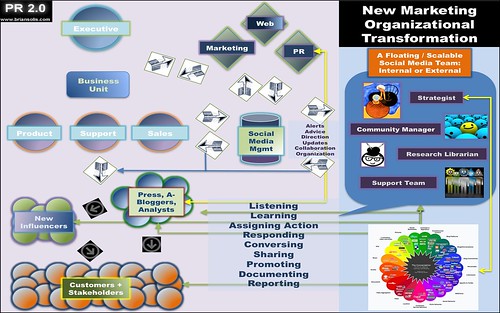
Real-Time Responsibilities (fully transparent and disclosed) of a New Media team could include:
Content Producers - Creates content necessary for client/company interaction with customers, peers and influencers, including videos, images, Web pages, blog posts, policies and guidelines, tweets, wikis, comments, online experiences, profiles, etc. In many cases, connectors and industry experts/strategists wear this hat and assign the creation of important content to either content producers, other members on the team with direct experience, or simply produce it themselves.
Digital Sociologists - Observes the cultures, trends, behavior, associated with communities, networks, forums and compares the interactivity around keywords and brands to contribute to engagement strategies, customer service policies and improvements and product modifications.
Digital Ethnographers - Ethnography is the branch of anthropology that deals with the scientific description of specific human cultures. For those projects where a deep study of online culture and communities is critical, an ethnographer is ideal for documenting a descriptive study of a particular human society. As ethnography is based almost entirely on fieldwork, this role usually lives and interacts with the people who are the subject of study.
Research Librarians - Complements or augments in house or contract sociologists by analyzing relevant keywords used by customers, listening to and documenting conversations by content and sentiment, charting volume and frequency within social networks, identification and analysis of true influencers and tastemakers across media, blogs, and social communities, and presents data and charts for analysis by strategists.
Community Managers - Listens to conversations in social networks, forums, and the blogosphere documented by research librarians or through their own process, assigns relevant dialogue to appropriate team leads, manages the workflow and response status, and in most cases is the first line of response.
Digital or Social Architects - Digital or social architects are responsible for building the online bridges between company brand and consumers via widgets, sites, online dashboards, blogs, social newsrooms, social media releases, wikis, social networks, fan pages, forums, groups, and any other application, platform, or group responsible for hosting content, conversations, and interactivity.
Connectors - Informed individuals and teams that can connect stories to influencers and inspire activity, direction, and conversations. Connectors act based on intelligence, empathy, sincerity and the ability to truly “bridge” a story to someone else in a way that’s specific and compelling to them as an individual and also as it relates to their audience and social graph.
Industry Experts/Strategists - Someone has to act as the conductor to this all star orchestra. Qualified individuals have mastered the art and science of attaching new and traditional media to the bottom line of their business and also possess a deep understanding of and experience with customer empathy, market trends, and the governing technology that connects the people within desired market places.
Yes, I said customer empathy...
As I said in the SXSW panel, which the Los Angeles Times picked up, "Get a little empathy going on. Putting an ear to the virtual ground will tell you everything you need to know -- it's going to affect and influence what you write, how you talk. It's going to make you a little more passionate, a little more believable."
These new, adjoined job functions create a new level of services that complement existing, traditional and necessary communications activities.
- Listening/Monitoring/Documenting – intelligence gathering and trend analysis
- Engagement in the networks and groups where relevant conversations are pervasive and warrant participation
- Content creation
- Conversation management and trafficking
- Influencer and tastemaker identification and networking
- Community management, empowerment, and cultivation
- Event hosting and franchising
- Story development and connectivity to “The Magic Middle” bloggers and Long Tail networks
- Humanizing company and product messaging and redefining the online journey and experience associated with the online presences associated with specific brand/products
The opportunities are limited only by the imagination of those responsible for engendering change from within.
Becoming the People You Want to Reach
In a recent survey conducted by the Institute for PR, most (92% - up from 89% in 2008) of those surveyed believe that blogs and social media influences news coverage in the traditional media (newspapers, magazines, radio and television). It most certainly influences the purchase decisions of customers.
But how do you spark word of mouth across the social web? How do you socialize relevant information across the social graphs of those who define your relevant networks?
Communities won’t react to a press release. Nor will communications professionals galvanize action because of a generic pitch.
They need inspiration and motivation and that can only stem from an interaction that is so compelling and engaging that they’re inspired to act and share. Essentially you have to become the people you wish to reach and excite.
Yes, transparency subjects you to public scrutiny. It also forces you to rethink your approach and the words you share with those you believe are qualified and amenable to hear them. It raises the bar and hopefully inspires a more personal and human interpretation tied to the nuances of the individuals you’re attempting to convince and inspirit.
When we start writing that pitch or crafting the first draft of the press release, we seem to lose touch with our inner consumer in favor of appeasing corporate management. But ultimately who are we writing for?
It’s a delicate line to traverse.
On one side of the equation, you serve the people that ensure you have a job; on the other side, you’re faced with a discerning group of influencers and ultimately people who communicate through experiences, pains and benefits and not hyperbole and innovations.
It’s as simple as this, stop speaking through pitch emails and press releases designed to satisfy the people who most likely don't or won't buy the product or service.
Do you really think that speaking in marketing tongues is what it takes to get someone to pay attention to you - especially in this attention economy?
If you talked to your friends and family the way you pitch reporters and bloggers, you’d get nowhere quickly. In fact, you’d lose face and favor. The same is true for Public Relations. You’re talking to real people, on their terms.
You are the customer.
Try starting with the #twitpitch. Based on the art of MicroPR, if you could summarize the story in 140 characters or less, then you’re well on your way to commanding the escalator pitch, which makes the elevator pitch seem like a luxury.
Yes this technique reverses the traditional inverted pyramid we’re so accustomed to using when writing any marketing material, particularly press releases.

But now, we can say more with less. It’s the poetry and power of brevity - the art of persuasion through sincerity and relevance.
Here’s an interesting story I thought I’d share...
I’m working with a company that set me straight at the beginning of our relationship. While he had heard nothing but wonderful things about my team, he simply said, don’t sell me. I understand that you can get us in the press and the blogosphere and increase the frequency of conversations related to us across social networks. But I need you and your team, to be “us.” We created this product and company with our life’s passion and I don’t need it pitched, I need it shared as a real solution for those with real pain as someone who truly lives and breathes it. I don’t want PR, I need a dedicated team of enthusiasts that not only get it, but represent its incarnation.
His request is not unique.
Our Future and Your Place Within It Rests is in Your Hands
After a decade of sharing new philosophies, techniques, tools, and strategies for evolving how we think about and practice new and traditional communications, it's become quite clear to me that an industry firmly settled in history and process will not change in unison. It will take the influence of globally dispersed beacons representing a new hope for Public Relations who will champion the change from within and also from the outside. These individuals reside in PR, but will also feature the emergence of collaborators and new competitors representing hybrids of Interactive and Web Marketing, Customer Service, Technical and Social Architecture, Digital Sociology and Research, Evangelists, and Community Catalysts.
This higher level of commitment and supporting tactics are the minimum ante to practice Public Relations today and tomorrow – and its minimum will continually increase over time (as it should have all along). Personalized value and genuine, transparent and meaningful conversations is what it takes to forge relationships and continued value, listening, and sustained benefits combined with a lot of YOU, is the emotional investment that nurtures loyalty and referrals.
As mentioned earlier, PR and marketing will not change until it has to...now, there’s no choice. PR is broken, but it is far from dead. The good news is that tomorrow's public relations strategies are already successfully practiced today. The architects of new communications are collaboratively building a bridge to the masses to help navigate a path to education and relevance, defining the future of public relations and socially aware marketing in the process.
Change is imminent and its traction and fate is tied to you.

GapingVoid
If it's one moral that I want you to embody after reading this paper, it's that YOU, and only you, are in control of your career and the ensuing success that you earn and deserve.
You have to become the very people you’re trying to reach in order to effectively create connections and inspire action. Execution is defined by engagement, earned relationships, and the ensuing activity that results from each interaction. You are involved at every point.
If you’re dedicated and resolved to learn, new thinking, case studies, education and insight are now a commodity on the Web. Everyone in this space is willing to help you, so take full advantage of it.
You learn, grow, and excel on your terms.
We ARE becoming the new influencers and therefore we must redesign the communications ecosystem in which we operate and our roles within it in order to change, grow, and thrive.
Welcome to the new standard of Public Relations and Marketing Communications.
How will you contribute to its evolution and practice?
Helpful Posts on PR 2.0:
- Is Twitter a Broadcast or Conversation Platform (or Both)?
- Is Twitter Evolving from the Facebook to the Myspace of Microblogs
- Time Spent on Twitter Soars by Over 3,700%, Facebook 700%
- Gazing into The Twitterverse
- This is Not a Sponsored Post: Sponsored Conversations & the FTC
- Reviving the Traditional Press Release
- Twitter, Acquisition vs. Retention
- You Are Significant
- The Art and Science of Blogger Relations - Updated eBook
- In Social Media, The SEC Protects Investors and Companies by Removing “Relations” from IR
- Twitter Flutters into Mainstream Culture: The New Competition for Attention Starts with You
- The Social OS, The Battle Between Facebook and Twitter is the New Mac vs. PC
- The Domino's Effect
- Can The Statusphere Save Journalism
- The Conversation Index
- Social Media Influences Buying Decisions
- Is Social Media Recession Proof?
- The End of the Innocence
- The Social Effect and Disruption Theory
- Twitter and Social Networks Usher in a New Era of Social CRM
- Humanizing Social Networks, Revealing the People Powering Social Media
- I Like You The Emerging Culture of Micro Acts of Appreciation
- The Ties that Bind Us - Visualizing Relationships on Twitter and Social Networks
- Make Tweet Love - Top Tips for Building Twitter Relationships
- Are Blogs Losing Their Authority to the Statusphere
- Twitter Tools for Communication and Community Professionals
- Reinventing Crisis Communications for the Social Web
---
Connect with me on:
Twitter, FriendFeed, LinkedIn, Tumblr, Plaxo, Plurk, Identi.ca, BackType, Social Median, or Facebook
---

Subscribe to the PR 2.0 RSS feed.

Kindle users, subscribe here.
---
Now available:

---
pr pr+2.0 pr2.0 public+relations marketing advertising interactive social+media socialmedia brian+solis social media media2.0 media+2.0 2.0 smo social+media+optimization marcom communication publicity advertising interactive spin brand branding change manifesto customer evolution
Please take your time...Read it. Breathe it in. Live the change you wish to see.
Source
Modern Public Relations was born in the early 1900s, although history traces the its roots and origins of practice back to the 17th century. Two years ago, the press release celebrated its 100-year anniversary.
While the communications industry has iterated with every new technological advancement over the last century, including broadcast mediums and Web 1.0, none however, have forced complete transparency prior to the proliferation of the Read/Write Web aka The Social Web aka Web 2.0.
It is this element of fundamental transparency of Social Media combined with its sheer expansiveness and overwhelming potential that is both alarming and inspiring PR professionals everywhere. At the minimum, it’s sparking new dialogue, questions, education, innovation, and also forcing the renaissance of the aging business of PR itself.
While some are already predicting the death of PR, I fundamentally believe that it’s simply the death of PR as we know it. As long as communications professionals want to learn and improve their craft, then we are positioned for evolution. No matter how much we think we know, we’re now equalized as an industry in order to reset, learn, and define and earn an invaluable role within the business cycle – again.
Contrary to popular belief, Social Media isn’t killing PR, but the business of PR IS in a state of paramount crisis. It’s not without merit however. Perhaps up until now, we have been our own worst enemy.
The Social Web, the democratization of content and the wisdom of the crowds is merely amplifying PR’s weaknesses and expediting the declination of a broken business model. As is, many of us are collectively contributing to its perceived insignificance and irrelevance.
But there’s hope and that hope is you...
Our future lies in our ability to shift PR from a business of publicity to a regiment of true “Public” Relations.
Abbreviating "PR" truncates the value of our role in one of the greatest transformations the communications industry has ever witnessed.
As good friend Nicole Jordan told me over dinner in NY recently, “PR stands for Press Release, not Public Relations. When people ask me what I do, I tell them that I’m in integrated communications – public relations today is about much more than press releases and pitching and I am so much more than just a PR person.”
Indeed. Just ask any executive what comes to mind when you say “PR” and note the common misperception shared by many decision makers.
The brutally honest responses, whether you agree or not, will represent more than we’d care to know or acknowledge. The assessments and responses will most likely span from “publicist” to “networker” to “press release” to some fallaciously degrading and sexist stereotypes of what PR people are, how they act, and what they look like. You’ll also summon war stories and bad experiences with PR people and agencies that unfortunately continue to reinforce the current state of PR crisis for the PR industry in general.
There are reasons we are where we are and unfortunately, the PR industry hasn’t hired a crisis communications team to alter or steer perception based on the industry-leading and groundbreaking work, results, and pioneering efforts of many.
Let's be honest. At one point or another, we as communications professionals HAVE contributed to this state of crisis.
Yes, I’m speaking directly to you.
I hold the mirror up as I comb through my professional endeavors.
I too am guilty of hitting send on spam blast emails and broadcasting “messages” at “audiences.” I have also contacted reporters without reading their work. I have been blinded by quantity, not quality. And, I have sacrificed the investment in relationships for the gamble of percentages, hoping to turn big campaigns into measurable pockets of coverage and visibility. My career, in the beginning, was defined by hits and coverage and whether those articles and stories were "on message."
Since the mid 90s and with the dawn of Internet, I’ve dedicated myself to not only reinventing how I practice public relations, but also sharing my experiences, successes, stumbles, and failures with others who care to learn and improve a global industry from the inside out.
To this day, I remain continually, focused on investing in positive, constructive, and highly detailed blueprints on how we, as a communications industry, must embrace the socialization of the Web to transcend the foundation and very essence of PR into a more meaningful, relevant, and lasting renaissance.
I join the ranks of many great and generous public relations and communications professionals who actively invest in its promise and overdue maturation to strengthen its hope and future while playing a role in the unification of those passionate people who are dedicated to its transformation. This is a position of which I'm still firmly rooted and committed.
PR Won’t Change Until It Has To
Social Media symbolizes a crossroads for public relations representing the decision we, as individuals, face in our career. In one direction, we can adopt the transparency and the expertise necessary to genuinely and sincerely connect directly with our customers, peers and the influencers who advise them. In the other direction, we can continue relying on hyperbole and jargon filled press releases for coverage, spamming targets with irrelevant information, maintaining a superficial and shallow knowledge of the products and industries we represent, and maintaining distant and removed relations with those we wish to cover our stories.
In 2007, I shared a heartfelt conversation with my good friend Tom Foremski, where we outlined the state of PR and also what was required in order to lead and also survive the transition to the new era of marketing communications. His observation was best distilled with a blunt and poignant statement, "PR won't change, until it has to.”
As long as PR agencies and consultants are profitable as is, why would they reinvent themselves?
As some of us are learning, not challenging the status quo, especially in this economy, is the most direct path to oblivion...unfortunately, many are learning of the perils of "doing this wrong" through public exposure in a very global town square.
Contemporaneously, other communications professionals or organizations are rushing to capitalize on the new gold rush by adding everything "social" to their menu of services, mission, and experience, misrepresenting the very premise of their ebbing capabilities to masquerade inexperience in an exaggerated cloak of proficiency and expertise. Even in the face of intense competition to own the conversation, agencies are simply folding in new “social” services governed by the same top-down processes that govern day-to-day traditional PR. It’s a survival vs. adaption philosophy.
Hugh MacLeod
United as an industry that is dangerously slow to heed repeated dire warnings and adopt new standards, we will fail. Divided as individuals hungry for education and advancement aligned with those thought leaders and proven practitioners of new communications, we can collectively assemble a new and powerful collective of streetwise revolutionaries who will effectively transform, magnify, and upgrade the infrastructure of PR.
As much as you hear that all of this advice is Marketing 101, the marketing infrastructure is actually designed to function counter-intuitively. Intention and execution are distances separated by reality. We speak through hyperbole, spin, specifications, statements, and top-down messages. We continue to broadcast these disconnected campaigns in an era when our intended recipients have “opted out” of any outreach that pushes an agenda on faceless audiences through unemotional voices without recognizing the people formerly known as the audience (thank you Jay Rosen).
Personal vs. Corporate Branding
Don’t limit your expertise to personal experience with the use of social tools and networks. Your credibility, reputation, and knowledge must represent your command of them in action, both successes and failures in real world b2b, b2c, and p2p (peer to peer) engagement – not simply based on your efforts tied to personal branding. It’s one thing to build a community around you and your online persona, it’s altogether something different and much more complex and sophisticated, to create and inspire an active and passionate community around a product, service, and ultimately a brand.
With the powerful undercurrent of Social Media surrounding our personal and professional activity, we are now brand managers, not only for the companies we represent, but also our personal brands and reputations as well. If you’re not proactively shaping and cultivating it, who is?
We are our own brand managers now, responsible for how our personal brand and reputation as well as those we represent, are perceived, embraced and promoted. We learn through listening and participation. There is no excuse for our complacency as the failure in today’s landscape is public, searchable, and enduring.
Here Come the Social Media Experts
Credit
Traditional PR and marketing is on the endangered species list and this is that moment in time when its fate is in the hands of those who are contributing to its evolution or its demise. The veritable problem is that those who are instrumental in its downfall are oblivious to it. Everything is reactive, based on economics or negative responses that threaten their position in the market.
However, Social Media is not our golden ticket. It is both an opportunity and a privilege.
Applying the old rules and methodologies of communications to the new world of parallel influence only expedites the irrelevance and resentment of public relations and marketers overall.
Some PR teams and agencies are attacking the evolving business of PR by hiring thought leaders and injecting them into an existing infrastructure that’s complicated by years of hurdles, broken lines of communication, politics, and a misaligned hierarchy that prevents the most qualified individuals from leading and participating in successful online engagement for the long term. At best, most everything is viewed as a "campaign."
Other brands and PR teams are also attempting to rally posts, articles and tweets by paying or giving away products in exchange for coverage and good will. The practice has already earned the attention of the FTC and they’re issuing guidelines to ensure that bloggers and now Twitterers disclose the fact that they’re paid, whether with money or products.
Even after highly influential journalists and bloggers such as Chris Anderson and Gina Trapani have published the names of individual PR 'un' professionals and organizations that they consider spammers, we still actively push our messages to anyone and everyone as if we are determined to destroy any hope and potential of success - all in the name of scoring that one hit that will earn accolades and erase all of our wrongs.
Are we not more than publicists, handlers or even worse, spammers?
Why are the most junior people within any organization maintaining direct dialogue with leading influencers within their industry?
PR has entrenched itself in a top-down model that places strategy and direction at the top, management in the middle, and execution at the bottom. In a sense, many organizations are putting its most inexperienced and unseasoned employees on the front lines of PR while guiding them with strategy based on previous experience and/or theory, which may or may not be outdated and ineffective in today’s diverse and potentially perilous communications climate.
Things move too quickly to not combine experience, strategy, and execution in one role.
With the new and pivotal opportunity presented by Social Media, we again, are mistakenly and unfortunately, applying the same methodologies to program planning and engagement.
Social Media didn’t “invent” conversations and it did notunearth online conversations either; nor did it provide, for the first time, platforms for consumers to share their thoughts, opinions, and advice. Online groups and opinion sites existed since Web 1.0. And, before that, bulletin boards and forums hosted online discussions.
Contrary to popular belief, there are actually relatively few “Social Media Experts.”
As I’ve said many times, the ability to master any subject that moves, adapts, transforms, and evolves so quickly is beyond mastering – at least for now. We are, for now, simply its dedicated students.
Even still, several Social Media experts are predominately selling strategy and consulting because right now, everyone is buying it. Unfortunately, they’re helping companies understand the mechanics of Social Media tools and “conversations,” showcasing and promoting capabilities, functionality, and also providing training, but still delegating the execution to more junior marketing professionals, including interns and students. Most of this is rooted in theory as instead of experience.
Again, why would we entrust our most important outreach and engagement to those who most likely have no bearing on the real life needs, pains, challenges, and choices of those we’re hoping to compel? Yet, they are the very teams we’re sending out to represent our brand each and every day. And expert guidance from the top doesn’t translate company-wide unless they’re part of the day-to-day team demonstrating and teaching through example.
So, when a blogstorm or Tweetquake erupts, who’s really to blame?
Do we condemn the less seasoned employees who are simply executing based on “expert” instruction or lack thereof? Do we hold leaders accountable because they’re the masterminds behind most outreach? Or, is executive management liable simply because their expectations are out of synchronicity with reality?
The answer is all of the above.
However, PR and social marketers will point to account managers because of their unattainable and out of touch presumptions. Senior level managers will charge those who fail with incompetence. Those on the front lines will charge their management with leading through ineptitude, but they still sign the checks.
With the radical changes underway in the communications and media spheres, we need to not only retrofit PR and marketing with new techniques and strategies, but reconstruct its entire model for the Social Web, accounting for the complex and elaborate two-way layers of traditional and new influencers and the communities that form around them and the ideas they represent.
We just have to reinvent how we structure, monetize, and capitalize on the opportunities that are ripe for the entire industry of qualified communications professionals.
Relationships Aren’t Built by Copying and Pasting Content
We’re not as far as you’d like to think. Here are two very recent and real examples of pitches that I’ve received:
Dear Brian, I love your blog. I read it all the time. You really are a thought leader on this front. Because of that, I have something that I think is really worth your time. We're launching a new social network for plants where people can share their recommendations and experiences and also comment on each other’s green thumbs. We are also introducing a new plant monitoring application that lets you know via gmail and text when you need to water or feed your plants.
I don’t write about plants. But just because I’ve written about “social networks” doesn’t necessarily mean I would ever cover a social network for plants.
Then there are also those PR people who are moving way too fast for their own benefit:
Hi Liz, I love reading GigaOM. CUT AND PASTE PITCH HERE.
That’s right. I’m not Liz and I don’t yet write for GigaOm. However, every day, I, along with every reporter and blogger out there, receive a significant number of shotgun aka “spray and pray” emails that are produced from pure mail merge factories,
Slow down.
You’re contributing to the atrophy of our profession. This is exactly the moment when we need to realize that we can offer more to the company we represent and the people we’re trying to reach.
Rather than trying to satisfy quotas, realize that the PR and marketing industries are undergoing an incredible metamorphosis, one that implores a "less is more" strategy, rooted in the connectedness of real people. In the era of the Social Web, a few key posts and articles in the right places, supported by an impassioned community bound by evangelism, success is significantly more profound, and immediately measurable. New PR suddenly starts to pave a clear and effective new path for day-to-day engagement for those who are ready to learn, mature and excel.
PR is So Much More than Media, Analyst and Blogger Relations
Credit: Ghedo
The business of PR slowly evolved away from public interaction and eventually transformed into a mechanism of media, analyst, and blogger relations to instill messages and attempt to manipulate public behavior.
PR = Publicity
This view of PR can be traced all the way back to Edward Bernays in the early 1900s. A nephew of Sigmund Freud, Bernays’ experimented with Freud’s ideology related to people's unconscious, psychological motivations and how they could be exploited or steered through communications and top-down influence. As a result, PR of today is more aligned with Media, Analyst and Blogger relations and not necessarily “Public” Relations.
Now that the creation and distribution of content has been democratized, everyday people are earning a level of authority that fundamentally works against the current model of current PR.
As described in my book with Deirdre Breakenridge, “Putting the Public Relations,” the Web, heightened with the proliferation of the read/write Web and the impending semantic Web, is forcing the integration of the “Public” back into Public Relations.
Applying the current process of pitch development and distribution has little to no impact on your numbers and your potential to survive the evolution of communications. In fact, this process works against you by alienating you and the brands you represent, closing valuable inroads to reach the very people who can make or break your business.
By simply adding bloggers to your mail merge or your “hit” lists, you are not adapting to the new landscape of influence and engagement, only contributing to its state of crisis. Bloggers are people too, and their in boxes are just as chaotic as those of their journalist counterparts.
Source
Social Media is bigger than simply integrating a Blogger Relations branch to your PR strategy. It’s an opportunity to engage directly customers and peers who either purchase or recommend the decisions of others. Engaging and inspiring these individuals requires new techniques, methodologies, and an undeniable understanding of who they write for and why they should care about what you represent.
The new world of influence demands customer empathy, evangelism, passion, expertise, and knowledge – everything else is disposable and takes away from your focus and potential.
Doc Searls spotlighted the people who define our audience on the other side of our messaging megaphones to magnify the reality that markets are conversations and that there really is no discernible market for our pitches and messages.
Over the years, my experience with direct engagement has revealed that conversations are also markets - within vertical segments. Traditional word of mouth, at the consumer level, is intensified as impassioned individuals now have access to new mediums that directly and indirectly influence the decisions of their peers in the real world and through their extended communities online.
So how does PR attempt to engage with these new influencers?
Other than pitching at them and broadcasting messages through any and all channels and networks, many PR people attempt to either pose as “users” or offer boilerplate comments and reviews across the blogosphere, in micromedia communities, online groups and social profiles and review sites. This isn’t participation. This is PR of old. It embodies the same spin that defines most press releases along with the disingenuous voices associated with ghost-written executive quotes, contributed articles and now blog posts.
Listen, engage, prioritize, and grow in the communities that affect your development, reputation, relationships and authority as a person and as a professional. It's the only way...
Listening is the fundamental characteristic that separates the experts from the theorists.
The process of actively observing and documenting relevant conversations not only enables the communications team to create an accurate social map of important and relevant networks, but it also produces a more informed and empathetic assembly of sincere, humanized evangelists and ambassadors. This is a critical observation and lesson. We emerge from the process of listening and internalizing in tune and in touch with our markets and the people who define and direct them.
Blasting messages to them now seems trivial and purposeless. Engaging, solving problems, and answering questions, essentially becoming community and customer resources becomes paramount and natural. We participate as consumers and ultimately as the customers we wish to reach. It fuses customer service and influence. As next generation communications professionals, we're walking a tightrope between earning attention and building community, without losing sight of our ultimate goal of propagating our value propositions.
It is the job of any good Public Relations professional to identify and guide influential voices within important online communities.
Transparency Begets Authenticity; Experience Engenders Authority, and Influence
Transparency scares the sh!t out of PR people. This is an industry that has long operated behind the puppet master’s curtain, pulling the strings for spokespeople and varying communications tools to broadcast content at, around, and through the back channel of influence, but never directly connecting with the people who define its audiences.
The democratization of content also dictates the success, “shareability,” and permeation of your story by revealing and refining it through public forums and channels – let the community guide how you approach them.
The Social Web forces you to participate as an individual, not as a marketer and thus requires a new depth of understanding, expertise, knowledge in order to establigh a meaningful relationship between customers, influencers, and the company and products you represent.
Whether you post a comment, write a blog post, upload a video, create a profile on a social network, or establish groups or fan pages, everything is now open to public dissemination, interpretation, and response. Email too, long considered a safe medium for exchanging or presenting information, is now backfiring for PR, fueling bloggers and media to respond with a deep-seeded necessity to seek retribution by posting of original pitches and creating public blacklists that absolutely devastate PR individuals and their standing within their respective industries. While I don’t agree with public humiliation, it is an unfortunate reality that we must contend with while fighting and promoting the ethics of human relationships. Nonetheless, the lesson here is that we are now forced to change how we approach people with our stories. It's for our own good and the overall betterment of our craft.
A New Business Model and Infrastructure for Public Relations
Credit: Pear Biter
At South by Southwest (SXSW) in March 2009, Erin Portman, Karly Hand, Peter Shankman and I participated in a highly anticipated and heavily attended session entitled, “Are PR Agencies Dead?”
Some people would object to the use of “dead” in the title of anything these days. But, is it really a tired discussion in the grand scheme of things? Maybe, it’s stale to those who ping pong the discussion in the echo chamber. But for the rest of the world, it’s a topic that is either new or soon to be introduced into their world.
The controversial session explored whether or not Social Media was killing PR or breathing new life into it. In the end, it’s actually a bit of both. And, along with it, Social Media is forcing the establishment of new business models, staffing infrastructures, and service portfolios.
To be clear, the practice of blindly broadcasting messages through poorly written press releases at audiences is dead. PR is NOT necessarily dead, but without the application of a social tourniquet, it is bleeding to death.
Essentially, this is a matter of livelihood and the evolution of marketing and PR is incredibly poignant to each and every one of us.
At the end of the day, we are now in the business of visibility, influence and perception management. So, we can now put away the white coats associated with spin doctoring. We can remove the blindfolds we wore in every mass blast we sent. And, we can hang up our plaid jackets associated with the snake oil salesmanship we were accused of oozing in every exchange.
We now need to rethink our roles as intermediaries between the companies we represent, authorities, and ultimately the communities that determine our place in the market. In order to persevere and excel, agencies, and the individuals who define them, must act as thought leaders and market makers, serving both sides of the conversation and also the ensuing activity and interaction.
The business model of billing for hours as related to press release writing, account management, news pitching, and traditional counseling is growing increasingly irrelevant in the face of new services and competition that PR never saw coming.
Suddenly we’re competing against interactive, advertising and digital agencies, community management teams, social media agencies, experiential specialists, branding and marketing consultants, or hybrid organizations combining all of the above.
Honestly, up until this point, we weren’t hired or paid, by in large, to connect, advocate, influence or believe, we were rewarded by the placements that result from mass pitching. When you run a campaign around “hits,” then it’s crafted and governed by numbers, not people.
As I mentioned during the panel, the public relations/new media agency that I run no longer bills for press release writing, account management, or standard pitching. These are now functions of more relevant social + traditional outreach and engagement programs. In fact over the last decade, we’ve completely redesigned our services infrastructure to reflect the real world business needs and goals of the companies we represent. It’s not absolutely definitive, but a promising work in progress that is very monetizable now and in the long-term. However, it requires not only new and conclusive services that combine standard communications and new media strategies, but also the associated metrics that justify the newer activity. In order to balance the new programming, we also shifted our billable infrastructure from a top-down agency model to a flat organization consisting of experts in the fields we represent as well as those who are fluent in the tools, channels and supporting cultures that foster influencer and customer interaction. Basically, we detonated the old infrastructure, kept the pieces that have and will always work, and connected everything to the new programs where we’re already seeing value today.
Ctrl-Alt-Del
There is no doubt in my mind that eventually all PR agencies and consultants will follow suit and transform from publicity firms into New Media communications and marketing organizations rich with in house or contracted content producers, digital sociologists, research librarians, community managers, digital architects, connectors, and industry experts/strategists.
But everything hinges on the ability to interpret trends, assess value and metrics, intelligently engage, and ultimately inspire change through proven results.
The function of socializing media within the organization could be relegated to a team of dedicated specialists before its deployed company or agency wide.
Real-Time Responsibilities (fully transparent and disclosed) of a New Media team could include:
Content Producers - Creates content necessary for client/company interaction with customers, peers and influencers, including videos, images, Web pages, blog posts, policies and guidelines, tweets, wikis, comments, online experiences, profiles, etc. In many cases, connectors and industry experts/strategists wear this hat and assign the creation of important content to either content producers, other members on the team with direct experience, or simply produce it themselves.
Digital Sociologists - Observes the cultures, trends, behavior, associated with communities, networks, forums and compares the interactivity around keywords and brands to contribute to engagement strategies, customer service policies and improvements and product modifications.
Digital Ethnographers - Ethnography is the branch of anthropology that deals with the scientific description of specific human cultures. For those projects where a deep study of online culture and communities is critical, an ethnographer is ideal for documenting a descriptive study of a particular human society. As ethnography is based almost entirely on fieldwork, this role usually lives and interacts with the people who are the subject of study.
Research Librarians - Complements or augments in house or contract sociologists by analyzing relevant keywords used by customers, listening to and documenting conversations by content and sentiment, charting volume and frequency within social networks, identification and analysis of true influencers and tastemakers across media, blogs, and social communities, and presents data and charts for analysis by strategists.
Community Managers - Listens to conversations in social networks, forums, and the blogosphere documented by research librarians or through their own process, assigns relevant dialogue to appropriate team leads, manages the workflow and response status, and in most cases is the first line of response.
Digital or Social Architects - Digital or social architects are responsible for building the online bridges between company brand and consumers via widgets, sites, online dashboards, blogs, social newsrooms, social media releases, wikis, social networks, fan pages, forums, groups, and any other application, platform, or group responsible for hosting content, conversations, and interactivity.
Connectors - Informed individuals and teams that can connect stories to influencers and inspire activity, direction, and conversations. Connectors act based on intelligence, empathy, sincerity and the ability to truly “bridge” a story to someone else in a way that’s specific and compelling to them as an individual and also as it relates to their audience and social graph.
Industry Experts/Strategists - Someone has to act as the conductor to this all star orchestra. Qualified individuals have mastered the art and science of attaching new and traditional media to the bottom line of their business and also possess a deep understanding of and experience with customer empathy, market trends, and the governing technology that connects the people within desired market places.
Yes, I said customer empathy...
As I said in the SXSW panel, which the Los Angeles Times picked up, "Get a little empathy going on. Putting an ear to the virtual ground will tell you everything you need to know -- it's going to affect and influence what you write, how you talk. It's going to make you a little more passionate, a little more believable."
These new, adjoined job functions create a new level of services that complement existing, traditional and necessary communications activities.
- Listening/Monitoring/Documenting – intelligence gathering and trend analysis
- Engagement in the networks and groups where relevant conversations are pervasive and warrant participation
- Content creation
- Conversation management and trafficking
- Influencer and tastemaker identification and networking
- Community management, empowerment, and cultivation
- Event hosting and franchising
- Story development and connectivity to “The Magic Middle” bloggers and Long Tail networks
- Humanizing company and product messaging and redefining the online journey and experience associated with the online presences associated with specific brand/products
The opportunities are limited only by the imagination of those responsible for engendering change from within.
Becoming the People You Want to Reach
In a recent survey conducted by the Institute for PR, most (92% - up from 89% in 2008) of those surveyed believe that blogs and social media influences news coverage in the traditional media (newspapers, magazines, radio and television). It most certainly influences the purchase decisions of customers.
But how do you spark word of mouth across the social web? How do you socialize relevant information across the social graphs of those who define your relevant networks?
Communities won’t react to a press release. Nor will communications professionals galvanize action because of a generic pitch.
They need inspiration and motivation and that can only stem from an interaction that is so compelling and engaging that they’re inspired to act and share. Essentially you have to become the people you wish to reach and excite.
Yes, transparency subjects you to public scrutiny. It also forces you to rethink your approach and the words you share with those you believe are qualified and amenable to hear them. It raises the bar and hopefully inspires a more personal and human interpretation tied to the nuances of the individuals you’re attempting to convince and inspirit.
When we start writing that pitch or crafting the first draft of the press release, we seem to lose touch with our inner consumer in favor of appeasing corporate management. But ultimately who are we writing for?
It’s a delicate line to traverse.
On one side of the equation, you serve the people that ensure you have a job; on the other side, you’re faced with a discerning group of influencers and ultimately people who communicate through experiences, pains and benefits and not hyperbole and innovations.
It’s as simple as this, stop speaking through pitch emails and press releases designed to satisfy the people who most likely don't or won't buy the product or service.
Do you really think that speaking in marketing tongues is what it takes to get someone to pay attention to you - especially in this attention economy?
If you talked to your friends and family the way you pitch reporters and bloggers, you’d get nowhere quickly. In fact, you’d lose face and favor. The same is true for Public Relations. You’re talking to real people, on their terms.
You are the customer.
Try starting with the #twitpitch. Based on the art of MicroPR, if you could summarize the story in 140 characters or less, then you’re well on your way to commanding the escalator pitch, which makes the elevator pitch seem like a luxury.
Yes this technique reverses the traditional inverted pyramid we’re so accustomed to using when writing any marketing material, particularly press releases.
But now, we can say more with less. It’s the poetry and power of brevity - the art of persuasion through sincerity and relevance.
Here’s an interesting story I thought I’d share...
I’m working with a company that set me straight at the beginning of our relationship. While he had heard nothing but wonderful things about my team, he simply said, don’t sell me. I understand that you can get us in the press and the blogosphere and increase the frequency of conversations related to us across social networks. But I need you and your team, to be “us.” We created this product and company with our life’s passion and I don’t need it pitched, I need it shared as a real solution for those with real pain as someone who truly lives and breathes it. I don’t want PR, I need a dedicated team of enthusiasts that not only get it, but represent its incarnation.
His request is not unique.
Our Future and Your Place Within It Rests is in Your Hands
After a decade of sharing new philosophies, techniques, tools, and strategies for evolving how we think about and practice new and traditional communications, it's become quite clear to me that an industry firmly settled in history and process will not change in unison. It will take the influence of globally dispersed beacons representing a new hope for Public Relations who will champion the change from within and also from the outside. These individuals reside in PR, but will also feature the emergence of collaborators and new competitors representing hybrids of Interactive and Web Marketing, Customer Service, Technical and Social Architecture, Digital Sociology and Research, Evangelists, and Community Catalysts.
This higher level of commitment and supporting tactics are the minimum ante to practice Public Relations today and tomorrow – and its minimum will continually increase over time (as it should have all along). Personalized value and genuine, transparent and meaningful conversations is what it takes to forge relationships and continued value, listening, and sustained benefits combined with a lot of YOU, is the emotional investment that nurtures loyalty and referrals.
As mentioned earlier, PR and marketing will not change until it has to...now, there’s no choice. PR is broken, but it is far from dead. The good news is that tomorrow's public relations strategies are already successfully practiced today. The architects of new communications are collaboratively building a bridge to the masses to help navigate a path to education and relevance, defining the future of public relations and socially aware marketing in the process.
Change is imminent and its traction and fate is tied to you.
GapingVoid
If it's one moral that I want you to embody after reading this paper, it's that YOU, and only you, are in control of your career and the ensuing success that you earn and deserve.
You have to become the very people you’re trying to reach in order to effectively create connections and inspire action. Execution is defined by engagement, earned relationships, and the ensuing activity that results from each interaction. You are involved at every point.
If you’re dedicated and resolved to learn, new thinking, case studies, education and insight are now a commodity on the Web. Everyone in this space is willing to help you, so take full advantage of it.
You learn, grow, and excel on your terms.
We ARE becoming the new influencers and therefore we must redesign the communications ecosystem in which we operate and our roles within it in order to change, grow, and thrive.
Welcome to the new standard of Public Relations and Marketing Communications.
How will you contribute to its evolution and practice?
Helpful Posts on PR 2.0:
- Is Twitter a Broadcast or Conversation Platform (or Both)?
- Is Twitter Evolving from the Facebook to the Myspace of Microblogs
- Time Spent on Twitter Soars by Over 3,700%, Facebook 700%
- Gazing into The Twitterverse
- This is Not a Sponsored Post: Sponsored Conversations & the FTC
- Reviving the Traditional Press Release
- Twitter, Acquisition vs. Retention
- You Are Significant
- The Art and Science of Blogger Relations - Updated eBook
- In Social Media, The SEC Protects Investors and Companies by Removing “Relations” from IR
- Twitter Flutters into Mainstream Culture: The New Competition for Attention Starts with You
- The Social OS, The Battle Between Facebook and Twitter is the New Mac vs. PC
- The Domino's Effect
- Can The Statusphere Save Journalism
- The Conversation Index
- Social Media Influences Buying Decisions
- Is Social Media Recession Proof?
- The End of the Innocence
- The Social Effect and Disruption Theory
- Twitter and Social Networks Usher in a New Era of Social CRM
- Humanizing Social Networks, Revealing the People Powering Social Media
- I Like You The Emerging Culture of Micro Acts of Appreciation
- The Ties that Bind Us - Visualizing Relationships on Twitter and Social Networks
- Make Tweet Love - Top Tips for Building Twitter Relationships
- Are Blogs Losing Their Authority to the Statusphere
- Twitter Tools for Communication and Community Professionals
- Reinventing Crisis Communications for the Social Web
---
Connect with me on:
Twitter, FriendFeed, LinkedIn, Tumblr, Plaxo, Plurk, Identi.ca, BackType, Social Median, or Facebook
---
Subscribe to the PR 2.0 RSS feed.
Kindle users, subscribe here.
---
Now available:
---
pr pr+2.0 pr2.0 public+relations marketing advertising interactive social+media socialmedia brian+solis social media media2.0 media+2.0 2.0 smo social+media+optimization marcom communication publicity advertising interactive spin brand branding change manifesto customer evolution
posted by Brian Solis at 6:27 AM
16 comments